
Blog
Pür Recording Studios
Posted on: 30 May 2026

Yesterday, on our way back from performing at Kozluyalı Glamping in Asos, Assos’da buluşma noktası, Turkey, I visited the brand-new, ultra-high-tech, and beautifully designed Pür Recording Studios on Cunda Island, Ayvalik, Turkey. I have recorded at some of the best studios in the world, such as Abbey Road and Air Studios in London, and yet I have never been in such a carefully designed studio in my life. Every recording scenario has been thought of and catered for, with attention to detail paid to all the needs one could think of for the recording musician.
The studio is the brainchild of Erce Kaşlıoğlu, co-founder and CEO of Telegrapher Loudspeakers. Erce kindly invited Erdem Güreler and me to dinner at the fantastic restaurant in the complex, then gave us a guided tour of the studios, a look at his wonderful collection of musical equipment (including some fantastic vintage synthesisers), and took time to explain the philosophy behind each space in the building.
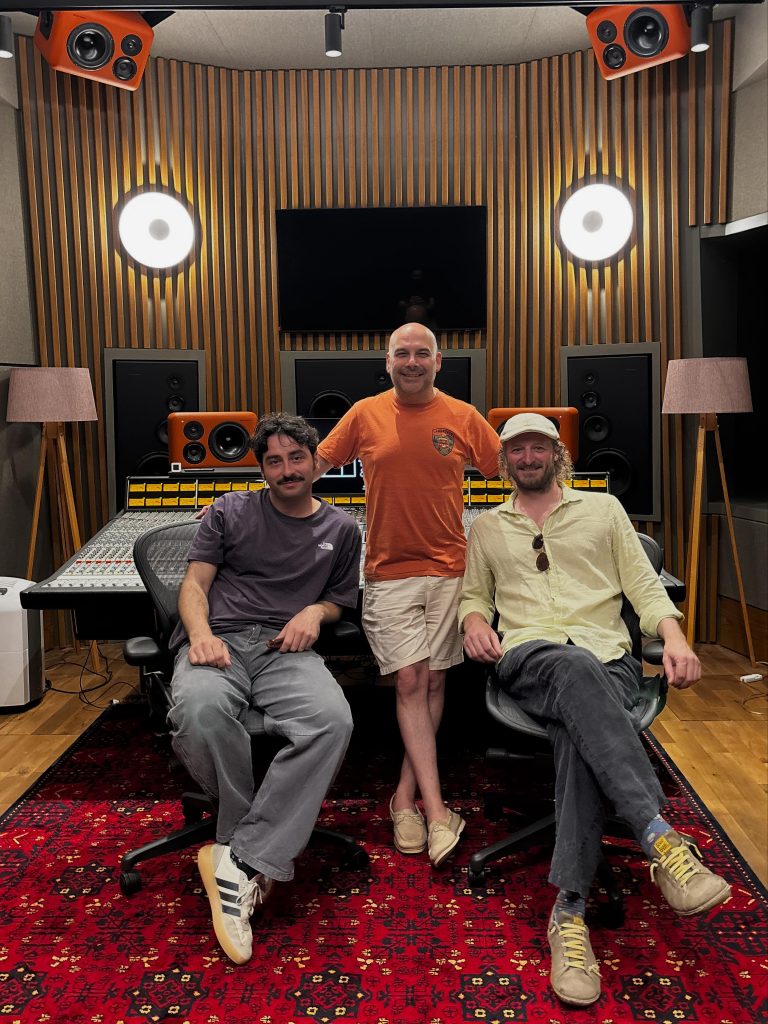
Here is Erce, Erdem and I in the control room of Studio A, which centred around a restored 48-channel SSL 4000 G+ with flush-mounted Telegrapher Rhino main monitors and orange Telegrapher Rhino midfield monitors. It also has a Dolby Atmos system using Rhinos, Elephant subs and ten Gorilla speakers around the control room:
Let’s take a closer look at that console behind us:

This is a 48-channel SSL 4000 G+ that was painstakingly restored over two years by the Dutch vintage specialist MARK1. They reconditioned every minor detail of the console and equipped it for a modern studio situation with all the automation required in such a setting.
For studio buffs, this is actually kind of a hybrid E/G-series SSL. Of its 48 channels, 16 have E-Series EQs and 32 have G-Series EQs, with the latter incorporating Mark1 modifications. PÜR has also added wet/dry control to every dynamics module. It also has a new AIM automation and recall system, which allows analogue console automation to be controlled from Pro Tools. It still retains the function as a control surface when engineers are mixing predominantly “in the box.” So it is effectively the best of both the analogue and digital worlds.
(And for the seriously nerdy studio enthusiasts, the rest of the signal chain is: Avid MTRX II conversion, alongside classic outboard including Universal Audio LA-2As and 1176s, Empirical Labs Distressors, API, Tube-Tech and DBX, plus preamps from BAE/Neve, Millennia, API, Rupert Neve Designs and Great River.)
The SSL 4000 also has a fascinating place in recording history. It was the console of choice for legendary British producer Trevor Horn, whose extraordinarily polished and ambitious productions helped define the sound of the 1980s. Horn installed an SSL 4000 at his SARM West studios in London and became such an enthusiastic advocate of SSL that he would eventually own several of the company’s consoles across his studios.
Here is Trevor Horn’s actual SSL from Studio 2 at SARM West, an SSL SL4048E+G, serial number 4101, installed brand-new in June 1983. It remained in Studio 2 continuously until SARM West closed at the end of 2014, and Horn retained ownership until 2017. Of the seven SSL consoles Horn owned over the years, this was the one he kept for 34 years. Coincidentally, this console aldso underwent a complete restoration by Mark Derksen of MARK1 Audio in Holland and was subsequently independently appraised by Peter Higgs of Mode Engineering – just as PÜR’s console:
 It was behind an SSL (and I guess mainly this one) that Horn and his team created and mixed records during an extraordinary period that included work with Frankie Goes to Hollywood, Grace Jones, Pet Shop Boys, Seal and Yes. The console was particularly suited to Horn’s approach: productions built from enormous numbers of musical and sonic elements, painstakingly assembled and shaped into highly controlled, dramatic mixes:

The SSL 4000 itself became one of the defining recording consoles of the era. Its combination of EQ, dynamics on every channel, sophisticated routing and computer-controlled automation transformed the way records could be mixed. Its famous bus compressor also became closely associated with the tight, cohesive sound of countless records — the effect engineers often describe as the SSL “glue.”
One of Pür Cunda’s earliest major classical projects brought internationally renowned Turkish pianist and composer Fazıl Say to Studio A. In January 2026, Say recorded Çılgın Nar Ağacı with mezzo-soprano Seda Kırankaya, a collaboration between two musicians who have worked together in various forms for around a decade. The album continues Say’s longstanding fascination with setting Turkish poetry to music, allowing Kırankaya to move between her classical training and a more natural, folk-influenced vocal language.
The filmed performance of Yorgun Çocuklardık, a setting of a poem by Ahmet Telli, provides a particularly beautiful glimpse into the studio itself: Say at Pür’s Fazioli F278 concert grand and Kırankaya singing in the expansive Studio A live room through a Neumann M149 Tube Set Condenser. The project was recorded by Pür’s classical producer Pieter Snapper, whose association with Say extends across more than twenty albums: