
Blog
Should Wedding Musicians Play During the Meal?
Posted on: 6 October 2026
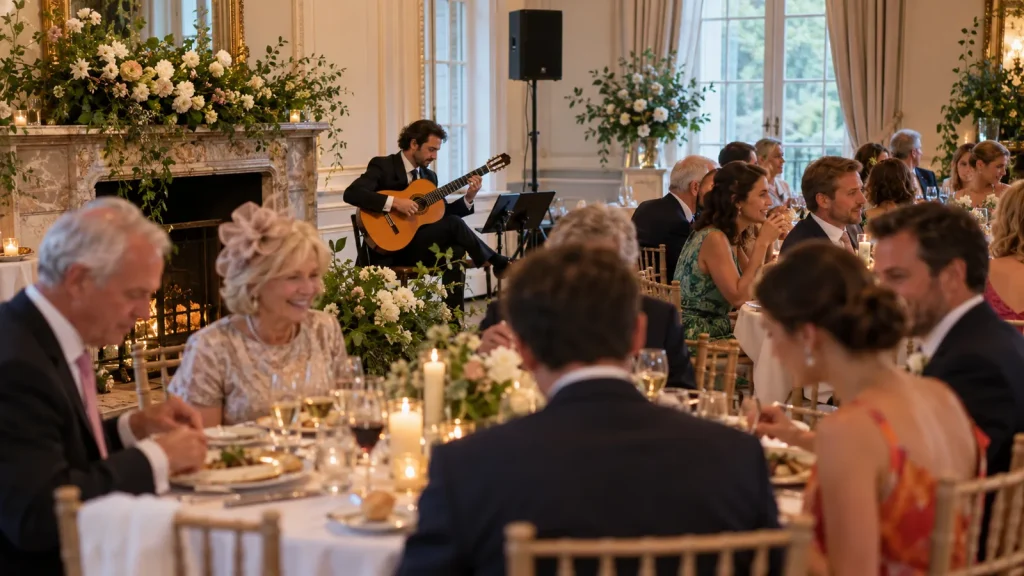
I think they can work extremely well during the wedding breakfast.
But the type of music matters enormously.
For me, this is not the moment for a big, energetic band. That comes later.
During the meal, the music should be light, elegant and unobtrusive enough that people can still talk comfortably.
The purpose is not to dominate the room.
It is to give the room an atmosphere.
The music should feel like part of the room
A wedding breakfast is a very social part of the day.
People are catching up, meeting relatives, talking across tables, eating, drinking and generally settling into the reception.
So the music should sit underneath all of that.
Solo guitar works particularly well for this because it can be melodic and interesting without being intrusive.
A small duo can also work nicely.
What I would avoid is anything too large or too powerful.
A full evening band during dinner can simply be too much.
You want the energy to build through the day, not peak too early.
Amplification matters — but it has to be even
I do think amplification is important.
The issue is not necessarily making the music louder.
It is making sure the sound is distributed properly around the room.
This is something people sometimes overlook.
If all the sound is coming from one speaker beside one group of tables, the guests nearest the speaker may feel that the music is far too loud, while the people at the opposite end of the room can barely hear it.
That is not good background music.
Ideally, the sound should be spread evenly enough that nobody feels they are sitting next to the performance and nobody feels completely disconnected from it.
This is why careful speaker positioning matters.
Good amplification during dinner should make the music feel present throughout the room without drawing attention to the equipment itself.
I would not use a DJ during the meal
Personally, I would save the DJ for later.
A DJ is excellent when the dancing begins because they can respond quickly to the room, take requests and keep the energy moving.
During the wedding breakfast, though, I think live music is much more appropriate.
There is something softer and more human about a musician playing quietly while people eat and talk.
The DJ’s role comes later, when the character of the evening changes.
One of the nicest moments is when guests first enter
I think one of the most important moments for music during the wedding breakfast is actually before everybody has sat down.
The room may begin almost empty.
One or two guests arrive.
Then another table fills.
Then a few more people come in.
Gradually the room comes to life.
I think it is lovely to have music already playing during that process.
For the first few minutes, you may quite literally be playing to two or three people.
That does not matter.
The music is setting the tone of the room before the room is full.
Without it, guests can sometimes walk into a large reception room that feels slightly empty or unfinished.
With live music already there, the room has an atmosphere immediately.
This is especially useful with a receiving line
If there is a receiving line, I think music becomes even more important.
Receiving lines can take time.
Guests are arriving gradually, greeting the couple or family members, finding their tables and waiting for everybody else to come through.
Light live music helps enormously during this period.
It fills the space without demanding attention.
It also prevents the atmosphere from feeling too formal or static.
In my view, there should almost always be some kind of gentle music during this part of the reception.
The entrance of the bride and groom deserves its own piece
Often the guests will all be seated before the bride and groom enter the room.
That gives you another lovely musical moment.
I think the musicians should think carefully about what they play at that point.
It can be treated almost like a second entrance.
Sometimes I will repeat the piece that was used for the aisle walk.
That can create a nice sense of continuity between the ceremony and the wedding breakfast.
Alternatively, you can choose something more celebratory.
A traditional piece such as Mendelssohn’s Wedding March can work very well here because everybody immediately understands what the moment is.
Whatever you choose, I think it is worth making the entrance feel different from the ordinary background music that surrounds it.
The repertoire can gradually become a little brighter
The music does not need to stay exactly the same throughout the meal.
At the beginning, I would normally keep things quite gentle.
As the room fills, people become more relaxed and the atmosphere becomes less formal, the repertoire can become slightly more upbeat.
That does not mean turning the wedding breakfast into a party.
It simply means allowing the music to follow the mood of the room.
A solo guitarist might move from classical pieces into Latin American music, jazz standards, bossa nova or familiar popular songs arranged for guitar.
The music can become more rhythmic while still remaining in the background.
People need to be able to talk
This is probably the most important rule.
Wedding breakfast music should never make conversation difficult.
If people are leaning across tables and raising their voices to speak to each other, the music is too loud.
That applies whether you have one guitarist, a string ensemble or a small jazz group.
The musicians should be aware of the room and adjust accordingly.
The right volume is one where people notice the music when they want to listen to it, but can also forget about it completely when they are talking.
That is exactly what good background music should do.
Speeches need to be built into the plan
The musicians also need to know when the speeches are happening.
There is usually no reason for live music to continue underneath speeches.
So if speeches are scheduled during or after the meal, the music should stop cleanly and resume afterwards if appropriate.
This is another reason not to think of dinner music as one long uninterrupted block.
It works much better in sections.
The musicians can play while guests arrive, perhaps another set during the meal, then stop for speeches.
If there is another musical section afterwards, it can begin once the formalities are over.
The energy should rise after the meal
One of the reasons I like keeping dinner music light is that it creates a much better contrast later.
After the wedding breakfast, everything can change.
The live band comes on.
The drums start.
The brass section appears.
The volume comes up.
People move away from the tables and towards the dance floor.
That change in energy is exciting precisely because the music has not already been operating at full intensity for the previous two hours.
A wedding day benefits from contrast.
The ceremony has one atmosphere.
The drinks reception has another.
The wedding breakfast is calmer.
And then the evening becomes something completely different.
So should you have live music during the meal?
I think the answer is yes, if it is the right kind.
Light live music can make the wedding breakfast feel much warmer and more complete.
It works particularly well while guests are entering the room, during a receiving line, and throughout the meal at a volume that allows conversation.
The important thing is not to treat the wedding breakfast like the evening party.
It is background music.
It should be elegant, evenly amplified and responsive to the room.
Then, once dinner is finished, you can let the energy rise.
That is when the bigger band, the DJ and the dancing can really begin.
Let us know if we can help in any way.