
Blog
What Can Go Wrong With Live Music at a Wedding — and How Do You Prevent It?
Posted on: 6 October 2026
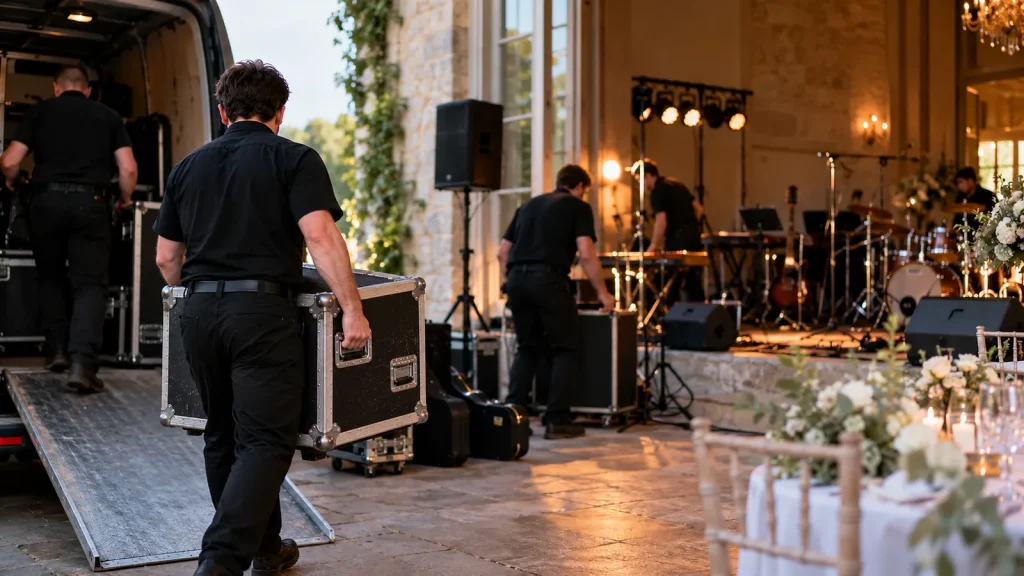
Most wedding music problems are not really musical problems.
They are usually logistical ones.
The musicians are in the wrong place. The equipment cannot get into the room. Nobody has told the sound company what is required. The ceremony is running 45 minutes late. The band is ready to set up, but the guests are already eating in the room. A beautiful outdoor performance area has no power. The venue has a sound limiter nobody mentioned.
None of these things is particularly dramatic on its own.
And almost all of them are avoidable.
The important thing is simply to think about them before the wedding day.
The musicians cannot get their equipment into the venue
This sounds ridiculously basic, but it is one of the first things worth checking.
A solo guitarist carrying one instrument and a small amplifier can get into almost anywhere.
A six-piece band with drums, keyboards, speakers, stands, microphones and lighting cannot.
A beautiful old building may have:
- narrow staircases
- no lift
- long corridors
- restricted vehicle access
- cobbled paths
- no loading bay
- a considerable distance between parking and the performance room
If the musicians have to carry everything through the same entrance being used by wedding guests, the timing becomes important too.
Nobody wants to see flight cases and speaker cabinets being pushed through the drinks reception.
So ask the venue:
Where do musicians unload, and when can they set up?
For larger bands, this is often more important than asking what time they actually start playing.
The musicians arrive and the equipment they expected is not there
This is one of the more dangerous assumptions in event planning.
The venue thinks the band is bringing a PA.
The band thinks the venue has a PA.
The sound company thinks somebody else has sent them the technical specification.
And everybody discovers the problem at 6pm.
If outside production is involved, make sure there is a very clear answer to:
Who is providing what?
That may include:
- PA speakers
- mixing desk
- microphones
- microphone stands
- stage monitors
- DI boxes
- power distribution
- lighting
- backline equipment
- drum kit
- keyboard
- music stands
For a solo performer, the list may be tiny.
For a larger act it can be substantial.
And if a third-party sound company is involved, somebody needs to make sure that the technical requirements have actually reached them.
Sending an email is not quite the same as confirming that the right person has received it.
The wedding runs late
Weddings run late.
Not always, but often enough that musicians should be expecting the possibility.
The ceremony may begin late.
Photographs may take longer than expected.
Guests may be slow moving from one part of the venue to another.
Dinner service may overrun.
And speeches are perhaps the least predictable part of the entire day.
This matters because musicians often have several sections planned.
A guitarist may be scheduled to play:
12:30 ceremony
2:00 drinks reception
5:00 wedding breakfast
But if everything slips by 45 minutes, the whole structure changes.
Usually this is manageable.
The important thing is to avoid designing a schedule in which every part of the day is dependent on the previous part finishing at exactly the planned time.
Allow some flexibility.
And if musicians have another engagement afterwards, make sure everybody understands the latest possible finishing time.
Nobody has told the band about the speeches
This happens surprisingly easily.
A band is told:
“You’re playing from 7pm.”
But nobody mentions that speeches will happen in the same room between 7:15 and 8:00.
Now the band has set up, perhaps started playing, and suddenly everything stops.
This is not necessarily a problem.
Musicians are used to stopping for speeches.
But it is much easier if they know beforehand.
The same applies to:
- cake cutting
- first dance
- fireworks
- surprise performances
- announcements
- special entrances
- venue curfews
Music works much better when it is designed around these moments rather than constantly interrupted by them.
The outdoor location has no power
That picturesque corner of the garden may look absolutely perfect.
It may also be 60 metres from the nearest electrical socket.
This does not automatically make it unusable.
Some musicians now use battery-powered amplification, and smaller systems can make outdoor performances surprisingly flexible.
But it needs to be known in advance.
If mains power is required, the venue needs to explain where it is and whether extension cables can be run safely.
Running a cable through an area full of wedding guests is not a very good solution.
It rains
This is an obvious one, but the contingency needs to be more specific than:
“We’ll go inside.”
Where exactly will the musicians go?
Will there be enough room?
Will the guests already be in that space?
Can the equipment be moved quickly?
Does the indoor area have suitable power?
Can a string quartet move easily, or are there chairs, stands and instruments to relocate?
Can a full band move at all once everything has been assembled?
If outdoor music is important to you, agree on the backup position before the day.
Then if it rains, nobody has to invent a new plan while standing in it.
The venue has a sound limiter
Some wedding venues have strict noise restrictions.
This is particularly common where a venue is close to residential properties.
Sometimes the venue simply has a maximum permitted volume.
Sometimes there is an electronic sound limiter that actually cuts the power if the music exceeds a certain level.
That can be particularly problematic for live bands.
An acoustic drum kit is not fitted with a volume knob.
If a venue has unusually strict restrictions, musicians need to know before they accept the booking.
There may be solutions.
Electronic drums, smaller amplification or a quieter type of act may work perfectly well.
But discovering the restriction during soundcheck is rather late.
There is not enough room for the band
Photographs of wedding venues can be deceptive.
A room can look enormous when empty.
Then you put 120 guests in it.
Add tables.
Add a bar.
Add a dance floor.
Add flowers.
Add catering stations.
And suddenly the spacious performance area in the brochure has disappeared.
Ask your musicians how much room they realistically need.
Do not try to squeeze an eight-piece band into the physical space required by a duo.
Apart from being uncomfortable, cramped stages can create practical problems with cables, instruments, microphones and speakers.
The musicians have nowhere to leave their equipment
This matters particularly when musicians perform during more than one section of the day.
Imagine a guitarist playing the ceremony at 1pm and then again during dinner at 6pm.
For several hours, there will probably be:
- instrument cases
- spare equipment
- bags
- cables
- perhaps a change of clothes
Ideally, there should be somewhere secure to leave them.
Expensive instruments should not have to sit unattended in a public corridor.
It is worth asking the venue whether there is a backstage room, storage area, office or other secure space available.
The first dance is not the version you practised to
This one deserves particular attention.
If you have practised your first dance repeatedly to the original recording, and then ask a live band to perform the song, make sure you hear or discuss their version beforehand.
The band may play it:
- faster
- slower
- in a different key
- with a shortened introduction
- with a longer ending
- using a different arrangement
None of that is necessarily bad.
But if you have choreographed something around a specific recording, small changes can suddenly feel very large.
Sometimes the original recording is actually the better choice for the first dance.
You can still have the band begin immediately afterwards.
A special song has been requested too late
If you want a musician to learn something especially for your wedding, tell them early.
A DJ can usually obtain a recording very quickly.
A live musician may need to:
- find an arrangement
- write an arrangement
- change the key
- rehearse it
- coordinate it with other musicians
For a solo guitarist, an arrangement can involve considerably more work than simply learning the chords.
If a particular song matters enormously to you, do not mention it three days before the wedding and assume it can automatically be performed.
Nobody is actually in charge
This is perhaps the most important point.
There may be:
- the couple
- the venue
- the wedding planner
- the band
- a DJ
- a sound company
- caterers
- photographers
- a toastmaster
- several other performers
Everyone can be excellent at their own job and the day can still become confused if nobody is coordinating the overlaps.
For larger weddings especially, somebody should know the whole entertainment schedule.
That does not mean they personally need to understand how a mixing desk works.
They simply need to know:
Who needs to speak to whom, and has that conversation happened?
A useful final check
A few days before the wedding, I would make sure somebody can answer these questions:
Where are the musicians performing?
What time can they arrive?
Where can they unload?
Who is supplying the sound equipment?
Has the band spoken directly to the sound company if necessary?
Is there sufficient power?
What happens if it rains?
Are there sound restrictions?
Where can equipment be stored securely?
Where can performers change?
When are the speeches, cake cutting and first dance?
Who is the contact person on the day?
If those questions have clear answers, most of the potential problems have already disappeared.
Good wedding music should look effortless
Guests should not really notice any of this.
They should see a band ready to play when the dancing begins.
They should hear music as they arrive for drinks.
They should see a guitarist sitting in exactly the right place as the ceremony begins.
They should never need to know that somebody arrived three hours earlier, carried equipment through a service entrance, ran cables, checked power, spoke to the venue manager and changed the schedule because dinner was running late.
That is the strange thing about good event planning.
When it is done properly, nobody notices it at all.