
Blog
What Happens if a Wedding Runs Late?
Posted on: 6 October 2026
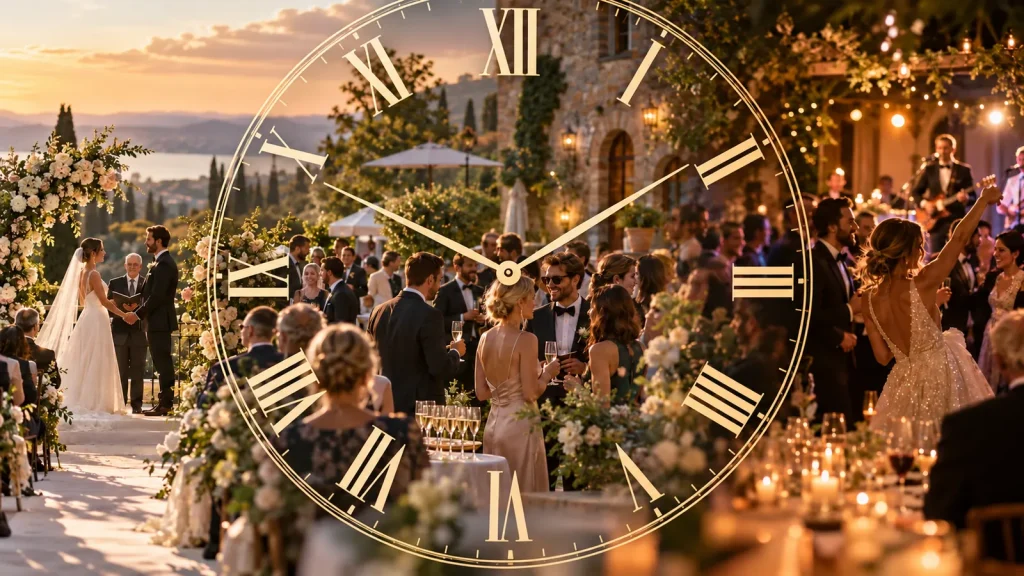
Wedding schedules are wonderfully optimistic things.
The ceremony begins at 2pm.
Drinks at 3pm.
Dinner at 5pm.
Speeches at 7pm.
Band at 8pm.
And occasionally, that is exactly what happens.
Quite often, it isn’t.
A ceremony starts late. Photographs take longer than expected. Guests are slow moving between spaces. Dinner service slips behind. Somebody gives a speech that was supposed to last five minutes and is still going twenty minutes later.
None of this is unusual.
The question is not really whether a wedding might run late.
It is what happens to the music when it does?
Some parts of the day can move quite easily
Certain types of live music are naturally flexible.
A guitarist playing during a drinks reception, for example, may simply begin slightly later.
If guests are still having photographs taken or have not yet reached the reception area, there is little point rigidly starting a set because the timetable says so.
This is one of the advantages of smaller acts.
A solo musician or duo can often respond to what is actually happening rather than what was supposed to happen.
The important thing is communication.
If the wedding coordinator knows that the ceremony is 30 minutes behind schedule, tell the musicians.
That sounds obvious, but it makes an enormous difference.
A delay does not always mean the music lasts longer
This is where expectations can become slightly complicated.
Suppose a musician has been booked from 2pm until 5pm.
If the ceremony begins 45 minutes late, it does not automatically follow that the musician can now stay until 5:45.
They may be able to.
But they may also have:
- another booking later that evening
- travel arrangements
- transport booked
- a contractual finishing time
- equipment that needs to be moved somewhere else
So if the day is running late, speak to them rather than assuming that everything simply moves forward.
Most musicians will try to be helpful.
But there is a difference between flexibility and suddenly adding another hour to a booking.
Sometimes it is better to shorten a section
Imagine a guitarist has been booked for:
- the ceremony
- a drinks reception
- the wedding breakfast
If the ceremony has started late and the drinks reception is consequently shortened, it may make much more sense simply to play a shorter reception set.
Trying to preserve every planned minute of music can actually make the rest of the day later.
This is where it helps to think about the purpose of the music rather than the number of minutes that were originally written down.
If guests have only 40 minutes for drinks before dinner instead of an hour, 40 minutes of live music may be absolutely perfect.
Nothing has been lost.
The day has simply changed shape slightly.
Dinner creates a different problem
Once food service is involved, musicians are no longer the only people working to a schedule.
The kitchen may need guests seated.
Waiting staff have courses to serve.
Speeches may be planned between courses.
The venue may need tables cleared before the evening reception.
If dinner begins late, it can have a knock-on effect throughout the rest of the evening.
This is one reason I would avoid planning live music too rigidly around exact clock times during the wedding breakfast.
It is usually better to think in terms of moments:
The musician begins once everybody is seated.
The music stops before the speeches.
The next set begins after the main course.
Those instructions are often much more useful than saying:
5:30–6:15pm.
Speeches are wonderfully unpredictable
If there is one part of the wedding day I would be reluctant to schedule too tightly around, it is the speeches.
You may have been told that they will last 20 minutes.
They may last 20 minutes.
They may also last an hour.
People tell stories.
People get emotional.
Someone unexpectedly decides to say a few words.
A best man discovers that his speech contains several additional chapters.
That is all part of the wedding.
But if musicians are waiting to begin immediately afterwards, somebody should keep them informed.
There is no benefit in having a band standing backstage wondering whether the speeches are about to finish while nobody tells them what is happening.
Evening bands are less flexible than a solo guitarist
A large evening band is a different operation.
There may be several musicians, a sound engineer, lighting, a PA system and a substantial amount of equipment.
The band may have been scheduled to soundcheck before dinner and begin at 8:30pm.
If everything is now an hour late, there may be several things to consider.
The venue may have a fixed finishing time.
There may be a noise curfew.
The band may have been contracted for a certain number of sets.
If the first set begins later, something may need to change.
Perhaps the intervals become shorter.
Perhaps two sets are condensed.
Perhaps the band plays later.
Or perhaps the venue simply cannot extend the finishing time.
This is one of those situations where the wedding planner, venue and band should make a decision together rather than everybody quietly hoping the timetable will somehow repair itself.
Venue curfews do not usually move
This is particularly important for evening entertainment.
If a venue must stop amplified music at midnight, then midnight normally means midnight.
Starting the band at 10pm instead of 9pm does not necessarily mean that they can continue until 1am.
The venue may have licensing restrictions, neighbours or contractual noise limits.
So if the wedding is significantly behind schedule, protecting the evening dancing may require shortening something earlier in the day.
That can sometimes be the better compromise.
Your musicians may be able to help
Experienced wedding musicians have usually seen schedules move before.
So ask them what they recommend.
A musician may say:
“We can skip the first break.”
Or:
“Let’s shorten the drinks set and keep the dinner set as planned.”
Or:
“We don’t need to play while guests are finding their seats. We’ll start once everyone is settled.”
These small adjustments can keep the music feeling natural without anybody noticing that the timetable has changed.
Do not let the guests see the panic
This is probably the most important principle.
If the wedding is running 40 minutes late, the guests do not need to know that the spreadsheet has collapsed.
They are probably having a perfectly nice time.
The bar is open.
They are talking.
Somebody is playing guitar.
Photographers are taking pictures.
From their perspective, everything may be completely normal.
Good event management is often about making changes invisibly.
The musicians, venue and planner adjust the schedule behind the scenes while the guests simply continue enjoying themselves.
Who should make the decision?
If you have a wedding planner, this should usually be their job.
If you do not, somebody should still have authority to make small decisions on the day.
It might be:
- the venue coordinator
- the best man
- a family member
- the entertainment coordinator
- somebody else you trust
What you do not want is five different people giving musicians five different instructions.
“You need to start now.”
“Don’t start yet.”
“We’re doing speeches first.”
“Actually the speeches have moved.”
That is when delays become confusing.
One person should have the final version of the plan.
Build some breathing room into the schedule
The easiest solution is simply not to create a timetable in which every section depends on the previous section finishing at precisely the planned minute.
A little breathing room is extremely useful.
If the ceremony is scheduled to finish at 3pm, do not necessarily design the next part of the wedding around something absolutely requiring everybody to be somewhere else at 3:01.
Allow people to move.
Allow photographs to happen.
Allow somebody to lose an aunt.
Allow the bride and groom to have five minutes to themselves.
Weddings involve lots of people, and lots of people take time to move.
The schedule should serve the wedding
The timetable is there to help the day work.
The wedding is not there to satisfy the timetable.
If something is running late, the best solution is usually the one that keeps the day feeling relaxed.
Sometimes that means shortening a set.
Sometimes it means moving one.
Sometimes the musicians can simply carry on.
Sometimes the evening band needs to change its schedule.
The important thing is that somebody notices what is happening, speaks to the people involved and makes a decision.
Because the guests should never be standing there wondering why nothing is happening.
Ideally, they should never know that anything went wrong at all.