
Blog
Can the Same Musicians Play for the Ceremony, Drinks Reception and Wedding Breakfast?
Posted on: 6 October 2026
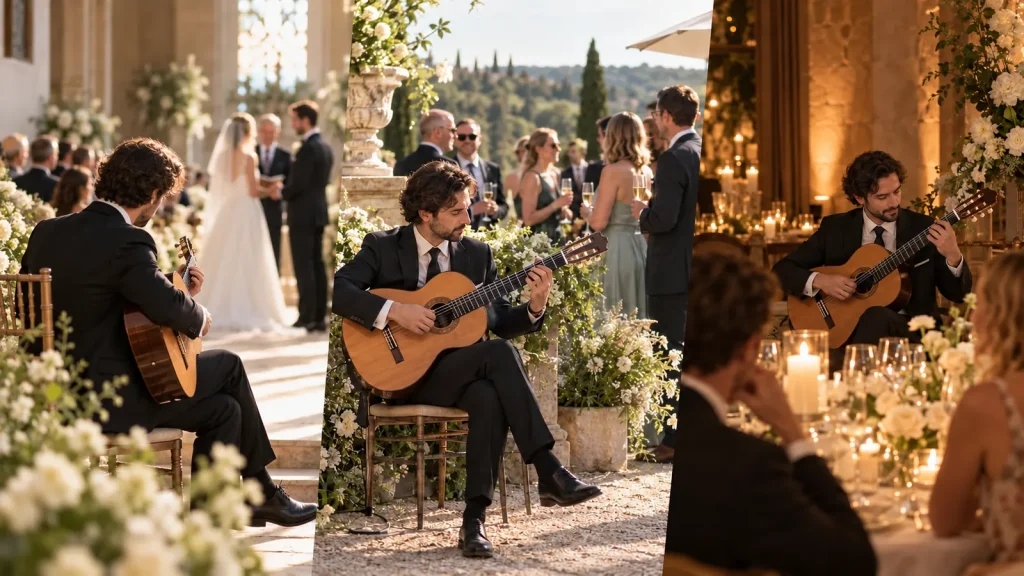
Yes — and I have done this many times.
In fact, one musician or one small act can work very well across all three parts of the day.
But the important thing is that the three sections should not all feel the same.
A wedding ceremony, a drinks reception and a wedding breakfast are quite different musical environments. Even if the same musician is playing throughout, the repertoire, volume and overall approach should change.
The ceremony is the most focused part
The ceremony is where the music is most exposed.
Certain pieces are not really background music at all.
The aisle walk, the signing of the register and the recessional are much closer to solo performance pieces. They are heard clearly, often in silence, and they carry quite a lot of emotional weight.
That means they need to be prepared properly.
The music should be chosen carefully, arranged carefully and played with enough presence that everybody can hear it.
The one exception is often the music before the ceremony begins.
As guests arrive and take their seats, the atmosphere is much closer to a drinks reception.
People are talking.
They are greeting each other.
There is movement.
At that stage, the musician is helping to establish the mood rather than giving a formal performance.
The drinks reception is much more social
Once the ceremony is over, the role of the music changes.
Guests are talking, having drinks, moving around and meeting people.
The music becomes more atmospheric.
It can be lighter, more rhythmic and slightly more relaxed.
This is where repertoire can open out.
For guitar, for example, I might move from more formal ceremony music into Spanish guitar, Latin American pieces, jazz standards or familiar songs arranged instrumentally.
The point is not to demand attention.
The point is to make the space feel alive.
The wedding breakfast is similar — but not identical
Playing during the meal has some similarities with the drinks reception, but it is not quite the same.
There is usually more background noise.
People are seated in groups and talking across tables.
Food is being served.
There may be glasses, cutlery and general room noise.
So the music has to sit within that environment.
I normally think of it as slightly upbeat, but still restrained.
You do not want to reach the energy of the evening party too early.
It is useful to think of the wedding day as a kind of musical crescendo.
The ceremony begins with something focused and formal.
The drinks reception becomes more sociable.
The wedding breakfast grows a little warmer and more relaxed.
Then, after dinner, the evening entertainment can become much more energetic.
That contrast is important.
Different sections should have different repertoires
One of the biggest mistakes would be to play essentially the same type of set three times.
Even if the same musician is covering the whole day, each section should have its own identity.
For me, separating genres can help.
The ceremony might lean more towards classical repertoire, carefully chosen popular arrangements and specific requested pieces.
The drinks reception might move into Spanish guitar, bossa nova, jazz or lighter popular material.
The wedding breakfast can continue in that general direction but perhaps become a little more rhythmic.
This way, there is continuity without repetition.
The musician remains familiar, but the atmosphere evolves.
Amplification can be a practical issue
This is one of the main logistical considerations if one musician is covering several parts of the wedding.
The ceremony may be in one location.
The drinks reception may be somewhere else.
The wedding breakfast may then take place in another room entirely.
Moving equipment between those areas can be awkward, especially if guests are moving at the same time.
Personally, I often take two separate amplification setups.
For the ceremony, I may use a small amplifier.
There is usually less background noise and the music does not need to be especially loud.
For the drinks reception and wedding breakfast, I may use a larger PA or speaker system.
That gives better coverage in a noisier space.
Having two setups also means I do not have to dismantle one system immediately after the ceremony and carry it through the wedding party while everybody is moving into the next part of the day.
Sometimes the most useful equipment is simply the equipment that is already in the right place.
The same musician can give the day continuity
There is also something quite nice about having the same musician appear at different points in the day.
The sound becomes part of the wedding.
Guests hear the musician as they arrive.
Then again during the ceremony.
Then later with drinks.
Then during dinner.
It gives a sense of continuity.
But that only works if the music develops with the day.
Otherwise, it can begin to feel repetitive.
The aim is not to play one very long set.
It is to create several distinct musical chapters.
A soloist or small act is particularly flexible
This is one reason solo musicians and small ensembles can work so well across several parts of a wedding.
They are easier to reposition.
They generally need less equipment.
They can adjust their volume more easily.
They can also change repertoire very quickly.
A large band is obviously much less practical in this situation.
Nobody wants a full function band setting up beside the ceremony, then moving to the terrace, then relocating again for dinner.
That is not really what they are designed for.
A solo guitarist, duo or small acoustic ensemble is much more adaptable.
You still need to plan the transitions
Even with a small act, it is worth thinking about the movement between sections.
If the ceremony finishes at 3pm and the drinks reception begins at 3:05pm in another part of the venue, the musician needs time to move.
That may sound obvious, but it is exactly the kind of thing that can be overlooked when the timetable is being planned.
It helps to ask:
- Where will each section take place?
- How far apart are those spaces?
- Does the musician need to move equipment?
- Is separate amplification available?
- Can one setup be prepared in advance?
- Is there enough time between sections?
A few minutes of planning can make the whole day much smoother.
Should you use the same musicians throughout the day?
Very often, yes.
For ceremony, drinks reception and wedding breakfast, a versatile solo musician or small act can work extremely well.
It can also be simpler than booking three separate performers.
But the key is variety.
The ceremony should feel like a ceremony.
The drinks reception should feel relaxed and sociable.
The wedding breakfast should sit comfortably beneath conversation.
And the evening should still have somewhere to go.
If the same musician can create those different moods, then using them throughout the day can give the wedding a really strong sense of musical continuity.
Can I be of more help? Contact me