
Blog
When Should Wedding Music Begin?
Posted on: 29 September 2026
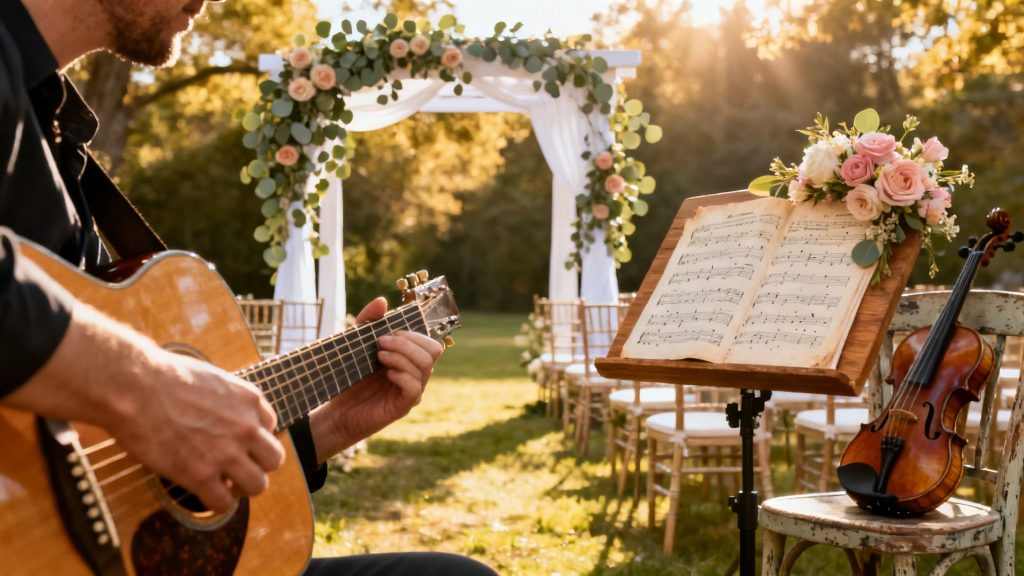
Should Your Wedding Guitarist Play as Guests Arrive?
If you have booked a solo guitarist to play for your wedding ceremony, there is a small decision that can make quite a considerable difference to the atmosphere of the room:
When should the live music begin?
Should the guitarist play while the guests are arriving and taking their seats? Or should the first notes of live music be saved for the entrance of the bride?
I was actually undecided about this for quite a few years.
Having played at many weddings, I have done it both ways. And there is a perfectly good argument for each.
The argument for saving the music for the aisle walk
There is something undeniably effective about silence—or at least the normal murmur of a room full of wedding guests—suddenly giving way to live music at precisely the moment the bride appears.
The change is immediate.
Everybody turns around, the atmosphere shifts, and the first notes of the entrance music announce that something important is happening.
For a long time, I felt that this was a good reason not to play beforehand. If the guitarist has already been playing for twenty or thirty minutes while everybody takes their seats, does the bridal entrance lose some of its musical impact?
It is a reasonable question.
And for several years, my answer was: perhaps.
But after playing many more ceremonies, I have gradually changed my mind.
Why I now prefer to play as the guests arrive
For most guests at a traditionally structured wedding, entering the ceremony room is really the beginning of the wedding.
They may have driven for several hours, checked into a hotel, changed clothes and found the venue—but this is the first moment when they actually become part of the occasion.
And what better way to begin?
Instead of entering a quiet room and wondering where to sit, guests walk into an environment where the wedding has already started to feel like a wedding.
There is live music.
There is an atmosphere.
There is a sense of occasion from the moment the first guest arrives.
That, for me, now outweighs the advantage of saving the first piece of live music for the bride’s entrance.
Live music also solves the awkward-silence problem
There is another, slightly less romantic, advantage.
Guests arriving at a wedding do not necessarily know one another.
One side of the room might contain university friends. Another might contain relatives who have not met for ten years. There may be work colleagues, neighbours, childhood friends and assorted partners who know almost nobody at all.
Put all of these people together in a silent room and the first few minutes can occasionally feel slightly awkward.
Live wedding music fills that space without demanding anybody’s attention.
It also provides one of the easiest conversation starters imaginable.
“What a beautiful location.”
“I love this song.”
“Isn’t the music beautiful?”
Suddenly two people who have never met have something in common to talk about.
And if they do not want to talk, that is fine too. There isn’t an uncomfortable silence waiting to be filled.
A solo guitarist can simply provide a musical backdrop while everybody settles into the room.
But shouldn’t the bride’s entrance still feel different?
Absolutely.
This was the thing that initially made me hesitate about playing during the arrival of the guests.
The entrance of the bride—or, of course, the entrance of either partner in a ceremony structured differently—should feel special.
If live guitar has already been playing for half an hour, the musician needs to make sure that the aisle walk does not simply sound like the next piece in the set.
Fortunately, there are several ways of doing this.
And this is where an experienced wedding musician can make quite a difference.
The importance of the pause before the entrance
One of the simplest techniques is also one of the most effective.
Stop playing.
A short period of silence immediately before the entrance does two things.
Firstly, it naturally quietens the room. Guests notice that something has changed and conversation begins to subside.
Secondly, it creates expectation.
After perhaps twenty minutes of gentle live guitar, even a short silence suddenly becomes noticeable.
Then the entrance music begins.
The effect can actually be stronger than simply introducing live music for the first time, because the guests have unconsciously become accustomed to the musical atmosphere and suddenly realise that something is about to happen.
Changing the sound for the aisle walk
There are also more subtle musical ways of separating the bridal entrance from the music that has come before it.
One is simply volume.
Guest-arrival music should normally sit comfortably underneath conversation. Nobody should have to raise their voice because there happens to be a guitarist in the room.
For the processional, however, I will usually bring the guitar slightly further forward.
Not dramatically—but enough for the music to become the focus rather than the backdrop.
I sometimes alter the sound itself too.
A little more reverb can be very effective. Reverb is essentially the natural echo or resonance that we associate with large spaces such as churches and concert halls.
Used excessively, it can sound artificial.
Used very gently, however, it gives the guitar a little more space and grandeur. Classical music can sound slightly more stately; a contemporary song can suddenly feel wider and more uplifting.
It is a small change, but small changes matter at moments like this.
Playing differently for the bride’s entrance
Perhaps the most important change, however, is not technical at all.
I simply play differently.
During the arrival of the guests, I am generally trying to create atmosphere without demanding attention. The music should be beautiful, but it should also allow people to greet one another, find their seats and talk.
The aisle walk is different.
Now the music is part of the event itself.
A guitarist can phrase a melody more dramatically, allow notes to breathe for longer, exaggerate a crescendo or give a familiar melody more emotional weight than they might during an ordinary performance.
In another context, this might almost seem slightly excessive.
But weddings are not ordinary contexts.
Walking into a café beside a train station on a Wednesday afternoon wearing a wedding dress might also seem slightly over the top.
At a wedding, it looks completely appropriate.
I think music works in much the same way.
The way I might play a melody as somebody walks down the aisle could feel overly romantic or grand in another setting. Accompanying a bride entering a beautiful ceremony room, however, that extra expressiveness suddenly makes complete sense.
The music should rise to meet the occasion.
What should a guitarist play while wedding guests are arriving?
The pre-ceremony music does not need to be the same style as the entrance music.
In fact, I often prefer some variety.
Classical and Spanish guitar work particularly well because they create atmosphere without becoming intrusive. Pieces by Bach or Tárrega can sit comfortably alongside a Spanish guitar piece, a jazz standard, bossa nova by Antônio Carlos Jobim or an instrumental arrangement of a well-known popular song.
The important thing is that the music feels welcoming.
This is generally not the moment for the most dramatic piece of the ceremony. That can be saved for later.
If the bride is going to enter to Canon in D, for example, I would usually avoid playing it during the guest arrival period. The entrance piece should retain its own identity.
Likewise, if a couple has asked me to arrange a song that has particular significance to them, I would normally save that arrangement for the moment for which it was chosen.
The guest-arrival music establishes the atmosphere.
The processional music marks the event.
Those are two slightly different jobs.
How long should the guitarist play before the wedding ceremony?
This varies from wedding to wedding, but somewhere around 20 to 30 minutes of live music before the ceremony often works very well.
It allows early guests to arrive to music without requiring such a long performance that the ceremony repertoire begins to feel repetitive.
Of course, weddings do not always run precisely to schedule.
One of the advantages of having a live musician rather than relying entirely on a recorded playlist is flexibility. If the ceremony begins ten minutes late, the guitarist does not reach the end of a playlist and stare nervously at the door.
We simply keep playing.
Likewise, when the signal comes that the bride or wedding party is ready, the music can be brought naturally to a close, followed by that all-important pause before the entrance.
So, should you have live music while your guests arrive?
My answer these days is yes.
There are certainly occasions where saving the first live music for the entrance might be the right artistic choice, and ultimately every wedding is different.
But in most circumstances, I think the benefits of welcoming guests with live music are greater.
It creates atmosphere immediately.
It removes awkward silences.
It gives guests something to listen to and even something to talk about.
Most importantly, it means that the experience of the wedding begins from the moment they walk through the door.
And I no longer think that this needs to diminish the impact of the bridal entrance.
With a pause, a carefully chosen processional piece, a subtle change in sound and—most importantly—a change in the way the musician plays, the aisle walk can still feel completely different from everything that came before it.
Perhaps even more so.
The guests have arrived.
The room is settled.
The music stops.
Everybody turns around.
And then the wedding really begins.