
Blog
Playing Anywhere with Battery-Powered Amplification
Posted on: 29 September 2026
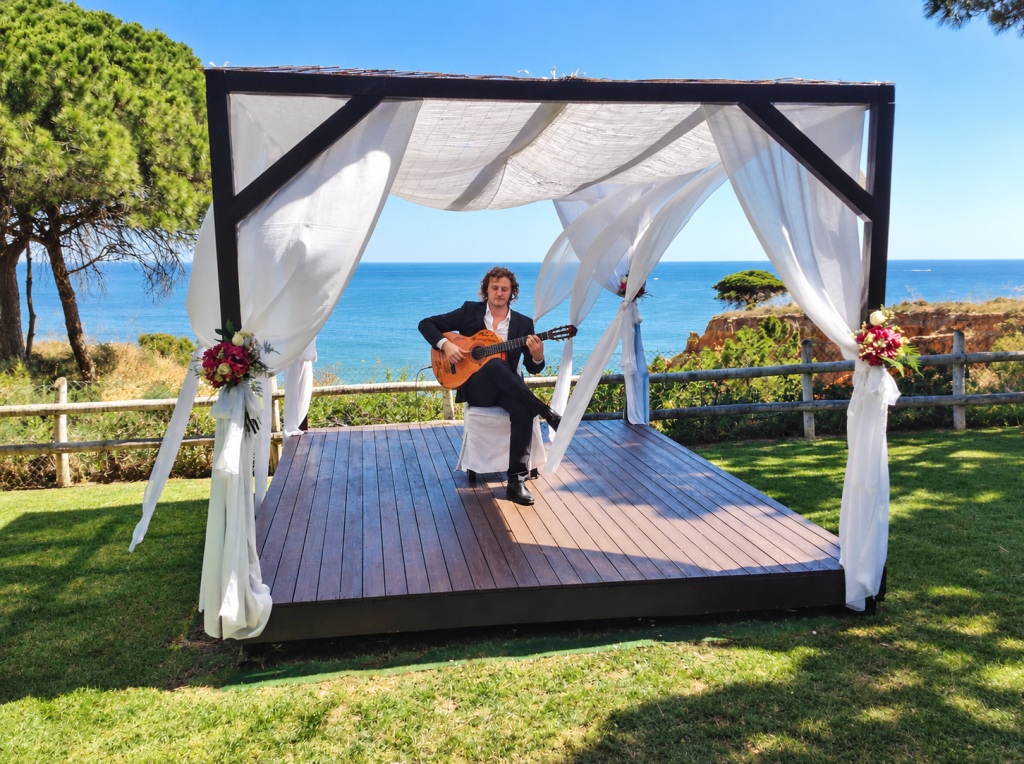
One of the great advantages of a solo guitarist at a wedding or private event is mobility.
A guitarist does not require a stage full of equipment. We can play in a ceremony room, move to a terrace for drinks, relocate beside the swimming pool and then perhaps move again for dinner.
There has traditionally been one small problem with this flexibility:
electricity.
Beautiful event venues are not necessarily designed around the electrical requirements of musicians.
And, perhaps unsurprisingly, the most attractive place to play is quite often nowhere near a power socket.
Recent developments in portable lithium battery technology have changed this considerably.
The Best Position Is Not Always Beside a Socket
Many wedding venues have beautiful grounds.
There may be a terrace overlooking the countryside, an old courtyard, a lawn beneath the trees or a viewpoint across a rolling landscape.
From the point of view of the event, one of these may be the perfect place for live music.
From the point of view of the musician, the first question traditionally had to be:
“Where is the nearest socket?”
That is not necessarily the most artistic way of deciding where the music should come from.
Battery-powered amplification removes much of this problem.
The musician can choose the position according to the guests, the acoustics and the appearance of the event rather than according to the electrical wiring of the building.
No Extension Cables Across the Venue
Extension cables have solved this problem for many years, of course.
But they are not always ideal.
A long black cable running across a lawn, courtyard or terrace is hardly the most attractive addition to a carefully designed wedding.
More importantly, cables need to be positioned safely.
Nobody wants guests in formal shoes stepping over electrical cables while carrying glasses of champagne.
Cables can be taped down or covered properly, but whenever they can be avoided entirely, that is even better.
A completely self-contained amplification system makes the setup cleaner, faster and more flexible.
Battery Power No Longer Means a Battery Amplifier
This is probably the biggest change.
For many years, if a musician wanted battery-powered amplification, the obvious solution was to buy an amplifier specifically designed to run from an internal battery.
Some of these products are very good.
But they inevitably restrict the musician to a relatively small selection of amplifiers.
Modern portable power stations offer a different solution.
A product such as the EcoFlow RIVER 3 Portable Power Station, for example, provides a conventional mains AC socket. This means that a normal high-quality amplifier can simply be plugged into it as though it were plugged into the wall.
For a working musician, the significance is simple:
I no longer have to choose my amplifier according to whether the venue has electricity.
I can choose the amplifier because I like the way it sounds.
Then I can make that amplifier portable.
Useful Outdoors — But Not Only Outdoors
The most obvious advantage is outdoor events.
Gardens, lawns, terraces, beaches and courtyards frequently have either no mains electricity at all or only one socket somewhere extremely inconvenient.
Battery power solves that immediately.
But the same principle can be useful indoors.
Old stone buildings, country houses, castles and historic venues were not necessarily designed with modern events in mind.
Some have relatively few electrical sockets.
Others have sockets in perfectly sensible places for lamps and vacuum cleaners but not necessarily in the corner where a guitarist would ideally sit during a drinks reception.
Even in a completely modern venue, the best position acoustically or visually may simply happen to be on the opposite side of the room from the nearest electrical outlet.
Once the amplification is independent of the mains, none of this matters very much.
The Music Can Follow the Event
There is another advantage that is particularly useful at weddings.
Weddings move.
Guests may arrive in one place, attend the ceremony somewhere else, walk outside for drinks and then move again for dinner.
A mobile amplification system allows the musician to move with them.
This is especially useful at venues with several attractive areas.
Rather than regarding one part of the venue as the fixed “music area”, the live music can become part of the movement of the day.
A ceremony might take place in a garden.
The drinks reception might then move to a terrace.
Later, dinner may be inside.
If the equipment is compact and self-contained, changing location becomes much simpler.
That flexibility is one of the reasons solo guitar works particularly well for weddings and private events.
Fast Charging Makes a Smaller Battery Practical
Battery capacity is obviously important, but capacity is not the only consideration for a working musician.
Weight and physical size matter too.
There is little point making the amplification system portable if the battery itself becomes another enormous piece of equipment to carry around.
Modern portable power stations can recharge remarkably quickly.
This is particularly useful at weddings because the musician does not necessarily need to run from battery power for the entire day.
There may be mains electricity available during dinner but not during the outdoor ceremony.
There may also be substantial gaps between different parts of the event.
In practice, this means that battery power can be used where it is genuinely useful, the system can be plugged into the mains when electricity is convenient, and the battery can be recharged between sections of the wedding.
For me, that makes a relatively small and lightweight power station particularly attractive.
Wireless Guitar Systems Make the Setup Even More Mobile
Electricity is only one cable.
The other obvious cable is the one running between the guitar and the amplifier.
A wireless guitar system removes that connection as well.
For a musician working at an event, this is not really about running around the venue while playing guitar.
It is about removing another restriction from the setup.
There is no cable trailing between the instrument and amplifier, the musician can reposition themselves more easily, and the whole performance area becomes cleaner.
I have written separately about wireless systems for guitar here:
[LINK TO WIRELESS GUITAR ARTICLE]
Battery power and wireless audio work particularly well together because both are solving essentially the same problem: allowing the musical setup to respond to the event rather than forcing the event to respond to the equipment.
Does Battery-Powered Amplification Compromise Sound Quality?
It need not.
This is perhaps the most important point.
The great advantage of a portable power station is that the amplifier itself does not have to be different.
If I have an acoustic amplifier whose sound I already know and trust, I can continue using exactly that amplifier.
The power source has changed.
The sound system has not.
And this connects directly to something I discuss in Is Amplification Necessary for a Wedding or Private Event?
Good amplification should not make a classical or Spanish guitar sound artificial or unnecessarily loud. The aim is to reproduce the natural character of the instrument and spread that sound evenly through the space.
A Small Technological Change with a Surprisingly Large Effect
Portable battery technology is not the most glamorous subject connected with weddings.
Nobody chooses a venue because they are excited about lithium batteries.
But from the musician’s point of view, this relatively mundane piece of equipment can make a surprisingly large difference.
It means fewer cables.
It means quicker relocation.
It means outdoor locations are easier.
It means the best place to position the musician no longer has to be the place nearest the socket.
And, perhaps most importantly, it means that musicians no longer necessarily have to compromise on the quality of their amplifier simply because mains electricity is unavailable.
The venue can determine where the music should be.
The scenery can determine where the music should be.
The guests can determine where the music should be.
The socket no longer has to.