
Blog
Is Amplification Necessary for a Wedding or Private Event?
Posted on: 29 September 2026
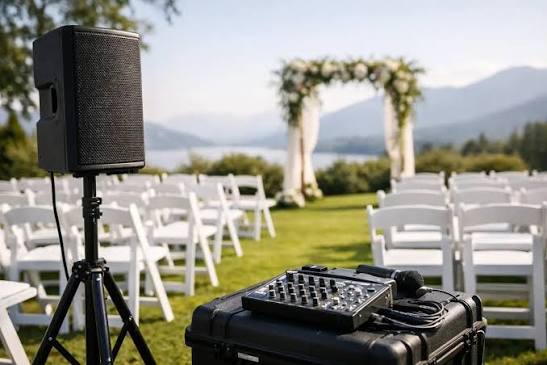
One of the questions that occasionally comes up when I am booked to play solo guitar at a wedding, drinks reception or private event is whether amplification is really necessary.
After all, the guitar is an acoustic instrument. If the event is relatively small, why not simply play without an amplifier?
The answer is that sometimes this works perfectly well.
But the natural volume of a solo guitar is often considerably lower than people imagine.
Two people having an ordinary conversation nearby can quite easily cover the sound of an unamplified classical or Spanish guitar. Add twenty, fifty or a hundred guests, the clinking of glasses, waiting staff, doors opening, chairs moving and the general noise of an event, and an acoustic guitar can disappear surprisingly quickly.
For that reason, I generally prefer to have amplification available.
That does not mean that the music needs to be loud.
Quite the opposite.
Amplification Does Not Have to Mean Loud Music
There is sometimes an assumption that once an amplifier or speaker is introduced, the music stops being background music and becomes a performance that guests are forced to listen to.
Good amplification should not work like this.
At a wedding drinks reception or small private event, the objective is often to create atmosphere while allowing people to continue talking comfortably.
The music should be present, but it should not dominate the room.
In fact, gentle amplification can often make background music less intrusive rather than more intrusive.
Without amplification, a guitarist may have to play considerably harder in an attempt to reach the other side of the room. With a good-quality amplification system, the sound can instead be spread gently and evenly throughout the space.
The result can actually feel much more natural.
The Aim Is an Even Spread of Sound
I once played at a wedding where I got talking to one of the guests. He was involved in developing an air-conditioning system designed to solve a very familiar problem: one part of a room can be freezing cold while another part is still too warm.
His objective was to create an environment in which everybody in the room experienced approximately the same temperature.
I remember thinking at the time that exactly the same principle applies to sound.
If background music is too loud for the people sitting next to the musician but barely audible to the guests on the other side of the room, something is wrong.
Ideally, everybody should experience roughly the same level of music.
This is partly a question of volume, but it is also a question of speaker positioning.
Sometimes one carefully positioned amplifier is sufficient. At larger events, two speakers may produce a much better result because neither has to work particularly hard. Instead of blasting the music from one corner of the room, the sound can be distributed much more evenly.
For background music, that is exactly what I want.
The Quality of the Amplification Matters
There is also a considerable difference between simply making an instrument louder and amplifying it well.
With a good acoustic guitar amplifier or PA system, the aim is to retain as much of the natural character of the instrument as possible.
If the system is small, well positioned and of sufficiently high quality, guests may barely notice that amplification is being used at all.
They simply hear the guitar.
This is particularly important with classical and Spanish guitar, where much of the beauty of the instrument lies in quite delicate differences of tone, dynamics and articulation.
A harsh or badly adjusted system can make a beautiful instrument sound unpleasant very quickly.
Good amplification should do the opposite: it should allow the natural sound of the guitar to reach everybody in the room.
How Much Amplification Does a Wedding Need?
There is no single answer because every event is different.
One of the questions I always ask before an event is:
How many guests are expected?
That immediately gives me an idea of the amount of amplification that may be required.
The size and shape of the venue also matter.
A wedding breakfast for thirty people in an intimate dining room is a completely different acoustic situation from a drinks reception for 150 people spread across several adjoining spaces.
Sometimes one amplifier is perfectly adequate.
Sometimes two speakers are preferable.
And occasionally I will use two completely separate amplification systems.
This can be useful when different parts of an event take place in different locations. For example, the ceremony may take place in one part of a venue and the drinks reception somewhere else entirely.
If there is not enough time between those parts of the day to move the equipment, set everything up again and soundcheck the second location, it can make much more sense to have both systems prepared in advance.
That way, I can simply move with the guitar.
Is Outdoor Amplification Different?
In principle, not enormously.
The same questions still apply: how many guests are there, how large is the space, and how evenly does the sound need to be distributed?
The main differences are generally volume and EQ.
Indoors, walls and ceilings reflect sound back into the room. Outdoors, the sound simply continues travelling away from the musician.
As a result, a little more amplification may be required.
Wind can also have an effect. Strong winds will usually cause bigger problems for an outdoor event than merely affecting the music, and many weddings will simply move indoors if the weather becomes too severe.
A gentle breeze, however, can still affect the way sound carries across an outdoor space.
Again, the solution is not necessarily to make everything much louder. Good speaker placement and careful adjustment are usually more important.
What If There Is No Electrical Socket?
This is where outdoor events present another very practical problem.
Many beautiful gardens, terraces, courtyards and lawns simply do not have convenient electrical sockets.
Traditionally, the solution was either a long extension cable or a battery-powered amplifier.
Neither option was always ideal.
Extension cables can be inconvenient, visually unattractive and, if badly positioned, potentially become a trip hazard.
Battery-powered amplifiers, meanwhile, historically meant choosing from a relatively limited range of equipment.
That has changed considerably.
Modern lithium battery technology now makes it possible to run high-quality professional amplification virtually anywhere at a venue without needing a nearby mains socket.
I have written about this separately in Playing Anywhere with Battery-Powered Amplification, because it has become one of the most useful developments for mobile musicians working at weddings and events.
[LINK TO BATTERY-POWERED AMPLIFICATION ARTICLE]
Should You Amplify a Solo Guitarist at a Wedding?
In most cases, I would say yes — gently.
That does not necessarily mean that amplification will always be used.
There are small ceremonies and intimate rooms where the natural guitar is perfectly sufficient.
But I prefer to have the option available.
If a client is convinced that amplification will not be necessary, there is very little downside to having a small amplifier waiting nearby.
If it stays in the car or changing room for the entire event, no problem.
But if the room fills with more people than expected, the drinks reception is moved outside, or the general noise level is higher than anticipated, then the solution is immediately available.
For weddings and private events, I have learnt that it is usually better to prepare for several possibilities rather than rely upon one.
The purpose of amplification is not to make a solo guitar loud.
It is simply to make sure that everybody who is supposed to hear it can do so comfortably.